Building a Circular City: A Solid-Waste Roadmap for ULBs
A practical, phase-by-phase solid-waste roadmap for Indian ULBs to move from disposal to circularity, aligned with SWM Rules 2016 and SBM-U 2.0, covering the full value chain from segregation to scientific disposal.
Most Indian cities still manage waste in a straight line: collect, transport, dump. A circular city breaks that line by keeping materials in use for as long as possible, recovering value from wet and dry waste, and sending as little as possible to landfill. For an Urban Local Body (ULB), this is not an abstract sustainability goal. It is a cost, land, and public-health decision that shows up every year in tipping fees, dumpsite fires, groundwater contamination, and Swachh Survekshan scores.
The good news is that the policy scaffolding already exists. The Solid Waste Management Rules, 2016 make source segregation, decentralised processing, and scientific disposal legal obligations for every ULB and bulk generator, and the Swachh Bharat Mission (Urban) 2.0 explicitly targets a shift toward a circular economy of waste and "garbage-free" cities. What is usually missing is not policy or even money, but a disciplined sequence that a ULB can actually execute ward by ward. This roadmap translates the mandates into that sequence, and shows where each actor in the waste value chain fits.
Understand the full waste value chain first
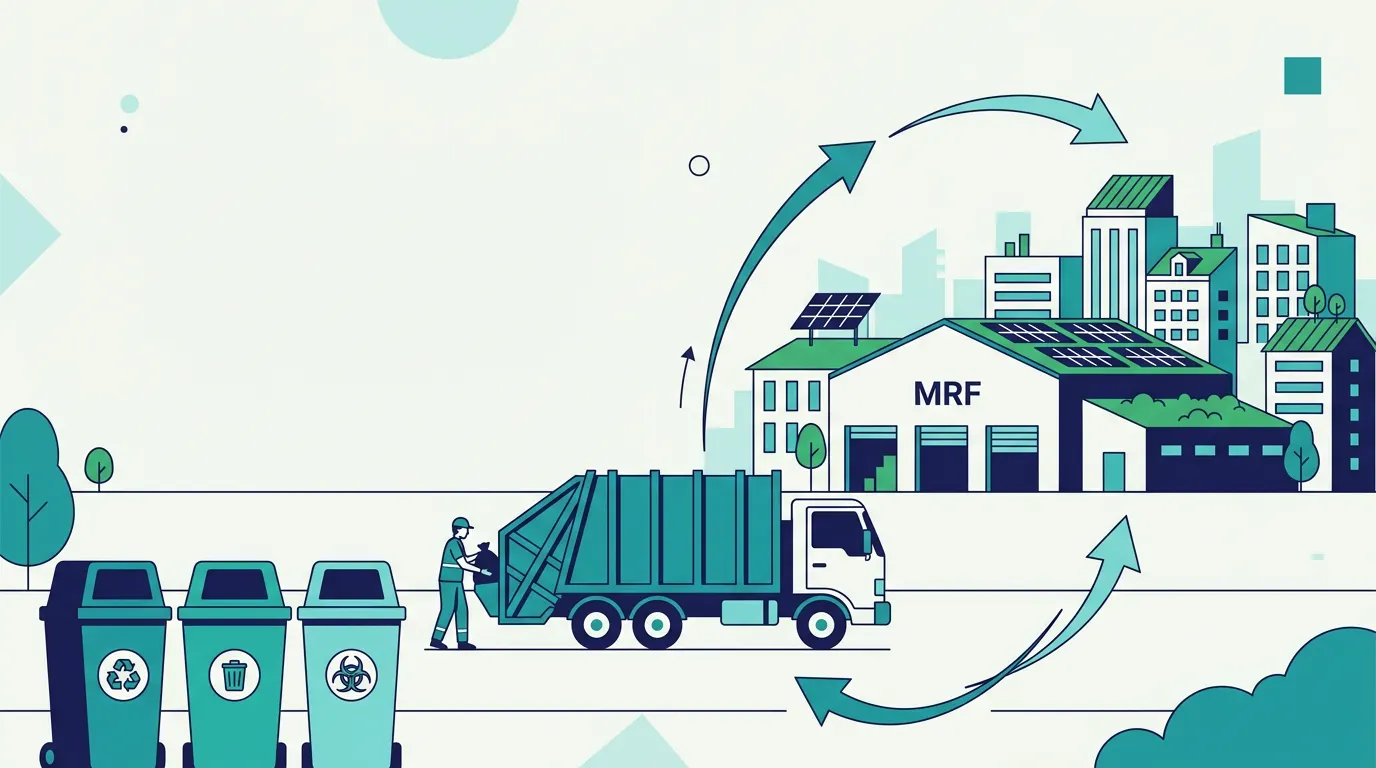
Circularity is a chain, and a chain is only as strong as its weakest link. Before redesigning anything, a ULB should map its own waste value chain end to end and be honest about where it currently breaks. The chain has five linked stages, and every one of them has to hold for the system to deliver.
- Segregation: households, shops, and bulk generators separating waste into wet, dry, and domestic hazardous fractions at the point it is produced.
- Collection: reliable segregated door-to-door pickup, so streams do not get remixed on the way out of the household.
- Transport: partitioned vehicles and secondary transfer that carry wet, dry, and hazardous streams separately to the right destination.
- Processing: composting or biomethanation for wet waste, material recovery for dry waste, and dedicated handling for special streams.
- Disposal: only genuinely inert, non-recoverable rejects going to an engineered sanitary landfill, never mixed municipal waste.
Know who does what in the system
A waste system is a set of people before it is a set of machines. The ULB owns the mandate and the budget, but delivery depends on a wider cast, and confusion about roles is a leading cause of failure. Assign responsibility explicitly across the operating model rather than assuming a contractor will absorb every gap.
- The ULB sets policy, funds and monitors the system, enforces segregation, and answers to citizens and to Swachh Survekshan.
- Safai karmacharis and collection crews perform daily door-to-door collection and street sanitation; their working conditions and route discipline decide coverage.
- Wastepickers and informal collectors already recover much of the dry recyclable stream and should be integrated, not displaced.
- MRF and composting operators, whether municipal, private, or cooperative, run the processing that gives waste its second life.
- Recyclers, farmers, cement kilns, and other offtakers are the buyers who actually close the loop by taking recovered material.
Start with a waste characterisation study
You cannot design a system for waste you have not measured. Before procuring vehicles or plants, commission a simple characterisation study across a representative set of wards and seasons. This tells you the wet-to-dry split, the share of recyclables, and the volume of inert and construction debris, which in turn decides how much composting or biomethanation capacity you need. Sizing a plant off a vendor brochure instead of your own waste is the most expensive mistake in the sequence.
- Sample across income levels, commercial zones, and seasons, not just one convenient ward.
- Record the biodegradable fraction separately; in most Indian cities it is the largest single stream.
- Use the results to size processing capacity rather than copying another city’s plant specifications.
Phase 1: Segregation at source and behaviour change
Circularity is impossible once streams are mixed, so segregation is the foundation. The SWM Rules require households and bulk generators to separate waste into wet, dry, and domestic hazardous fractions. Technology cannot substitute for this; a resident who mixes waste at the bin contaminates everything downstream. The lever here is not hardware but behaviour, which is why sustained Information, Education and Communication (IEC) matters as much as any vehicle purchase.
Effective behaviour change is patient and specific. A ULB should distribute or mandate two-bin systems, run door-step demonstrations rather than only wall paintings, involve resident welfare associations and schools, and, critically, stop collecting mixed waste so that segregation becomes the only path. IEC that runs for a few weeks around a launch fades; IEC treated as a permanent function of the sanitation department is what changes habits for good.
Phase 2: Collection and transport integrity
Segregated waste is only useful if it stays segregated. That means partitioned collection vehicles, fixed routes and timings, and an end to informal transfer points where streams get re-mixed. GPS-enabled vehicle tracking and route monitoring help enforce discipline and give the ULB the data it needs to prove coverage rather than merely assert it. Reaching and holding 100% door-to-door collection is a heavily weighted Swachh Survekshan parameter, and it is far easier to sustain when every beat is mapped to a named vehicle and crew.
Phase 3: Decentralised processing
The cheapest tonne of waste to manage is the one you never transport across the city. Decentralised wet-waste processing keeps organic material close to where it is generated and reduces vehicle costs and landfill load, while dry waste is consolidated at material recovery facilities where it can be sorted into sellable grades. Matching the technology to the scale and to the characterisation study, rather than defaulting to a single large centralised plant, usually produces a more resilient and cheaper system.
- Composting or biomethanation for wet waste, sized ward-by-ward or cluster-by-cluster.
- Material recovery facilities (MRFs) where dry waste is sorted into recyclable grades and residuals.
- Refuse-derived fuel (RDF) preparation from the high-calorific combustible fraction where a kiln offtake exists.
- Dedicated channels for domestic hazardous waste, sanitary waste, and construction and demolition debris.
Phase 4: Market linkage and circular value
Recovered materials only close the loop if someone buys them. Build offtake before you build capacity: Fertiliser Control Order (FCO) compliant compost for farmers and landscaping, sorted plastics and paper for recyclers, and RDF for cement kilns where feasible. Extended Producer Responsibility obligations on brand owners can also be a source of demand and co-funding for dry-waste systems. A processing plant with no confirmed buyer simply converts a heap of waste into a heap of unsold product, so market linkage is a design input, not an afterthought.
Phase 5: Legacy waste and scientific disposal
A circular city still has to deal with its past. Old dumpsites can be reclaimed through bio-mining and bio-remediation, in which aged waste is excavated, stabilised, and screened into a soil-like fine fraction, a combustible RDF fraction, recoverable recyclables, and a small inert residue. This frees land and removes a chronic pollution and fire hazard. New disposal should be limited to genuinely inert rejects in engineered sanitary landfills, sized for rejects only, so the city never builds its next mountain.
Govern it like infrastructure, and monitor relentlessly
Circularity fails when it is treated as a campaign rather than a system. Assign clear ownership, budget for operations and maintenance rather than just capital, and track a small set of hard metrics reviewed on a fixed cadence: segregation rate, collection coverage, processing rate, and percentage diverted from landfill. Publish them. A ULB that measures these numbers monthly will out-perform one chasing a dozen vanity indicators, and will climb the Swachh Survekshan rankings as a by-product rather than as the goal.
Common pitfalls that derail the roadmap
- Buying plants before securing segregated feedstock, so capacity sits idle or processes contaminated waste.
- Treating IEC as a one-off launch rather than a permanent function, so segregation rates slide back within months.
- Ignoring the informal sector, then paying more for capital-heavy sorting that recovers less.
- Skipping the operations and maintenance budget, leaving good infrastructure to fail for want of a small recurring line item.
How Social Lab helps ULBs and CSR partners
Social Lab works alongside municipalities and their CSR funders to design and run circular waste systems that are anchored in the ULB rather than parallel to it. That includes characterisation studies to size the system correctly, IEC and behaviour-change programmes to lift segregation, GPS-enabled collection monitoring, decentralised processing and MRF setup, wastepicker integration, and the monitoring and evaluation that proves outcomes to funders and Swachh Survekshan assessors alike. The emphasis is always on handing over a system a city can sustain on its own budget, not a demonstration that collapses when the project ends.
Key takeaways
- Circularity is a sequence, not a purchase: get segregation, collection integrity, and one working processing stream right before scaling.
- The SWM Rules 2016 and SBM-U 2.0 already mandate the outcome; the gap is disciplined, monitored execution across the value chain.
- Size the system from your own characterisation study and secure offtake before building capacity.
- Govern waste as monitored infrastructure with an O&M budget, not as a campaign, and integrate the informal sector rather than replacing it.
Frequently asked questions
Where should a ULB with limited funds start?
Start with source segregation and collection integrity, backed by sustained IEC. These are the lowest-cost, highest-leverage steps, and without them any downstream processing plant will underperform. A city that segregates and collects reliably has already unlocked most of the value; expensive plants added on top of mixed waste rarely pay back.
Is centralised or decentralised processing better?
For wet waste, decentralised processing close to the source usually wins because it avoids long-haul transport and reduces the risk of a single point of failure. Dry waste, by contrast, often benefits from consolidation at MRFs where sorting to sellable grades is more efficient. Let your characterisation study and available land decide the mix rather than a fixed rule.
How long does the transition to a circular system take?
Behaviour change and system redesign are multi-year efforts, not single budget cycles. A ward can show strong segregation and collection within months, but city-wide circularity, legacy remediation, and durable market linkages typically unfold over several years. The key is to phase the work so each stage is stable before the next is loaded on top of it.
Get a free, no‑obligation assessment from our team — we reply within one business day.