
Building a Corporate Carbon Footprint: Scope 1, 2 and 3 Emissions Explained
A practical guide to measuring your organisational carbon footprint using the GHG Protocol, from direct emissions to the tricky Scope 3 value chain and its 15 categories.
Before a company can reduce its emissions, set a net-zero target, or answer a customer questionnaire, it has to measure its carbon footprint. A corporate carbon footprint is the total quantity of greenhouse gases attributable to an organisation over a defined period, usually expressed in tonnes of carbon dioxide equivalent (tCO2e) so that different gases - carbon dioxide, methane, nitrous oxide and others - can be compared on a common scale using their global warming potentials.
The globally accepted method for doing this is the Greenhouse Gas Protocol, which organises emissions into three scopes. Getting the scopes right is the foundation for everything downstream, including BRSR disclosures, BRSR Core assurance, customer value-chain requests and any credible reduction target. This guide walks through the scopes, how to set your boundary, how to calculate each scope, and the standards that give your footprint credibility.
The GHG Protocol and the three scopes
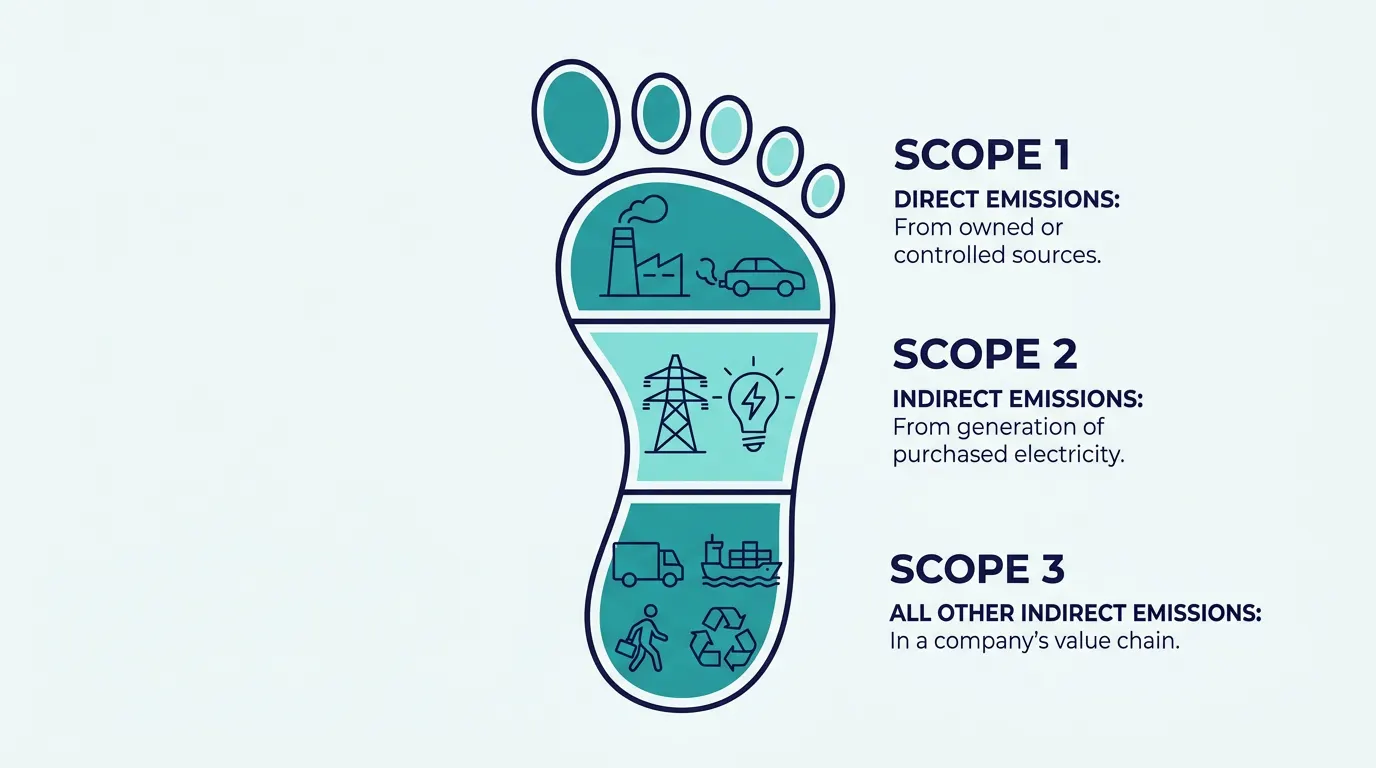
The GHG Protocol splits emissions by where they physically occur and by who controls them. This prevents double counting between companies and makes footprints comparable across organisations and sectors.
- Scope 1 - direct emissions from sources the company owns or controls: fuel burned in boilers and furnaces, company-owned vehicles, process emissions from manufacturing, and fugitive emissions such as refrigerant leaks.
- Scope 2 - indirect emissions from purchased energy: mainly the electricity you buy from the grid, plus any purchased steam, heating or cooling consumed at your sites.
- Scope 3 - all other indirect emissions across the value chain: purchased goods and services, capital goods, upstream and downstream transport, business travel, employee commuting, use of sold products, and end-of-life treatment, among others.
Setting your organisational boundary
Before counting a single tonne, decide which parts of the business are inside your footprint. The GHG Protocol offers two consolidation approaches: the operational control approach, where you count facilities you operate, and the equity share approach, where you count emissions in proportion to your ownership stake in each operation.
Most companies use operational control because it aligns with the sites they can actually influence and reduce. Whichever you choose, document it clearly, because the boundary must be applied consistently across every metric and every period, and it is one of the first things an assurer will check. A boundary that shifts between years or between metrics is the single most common cause of assurance findings.
How to calculate Scope 1 and Scope 2
Scope 1 and 2 are the most tractable and are where every company should start. The basic method is to multiply activity data by a published emission factor to arrive at tCO2e.
- For Scope 1, gather fuel consumption (litres of diesel, cubic metres of natural gas, kilograms of LPG) and refrigerant top-ups, then apply published emission factors to convert each to tCO2e.
- For Scope 2, collect electricity consumption in kilowatt-hours from utility bills and apply the relevant grid emission factor. Report both a location-based figure, using the average grid factor, and a market-based figure, reflecting any renewable energy or green tariffs you have procured.
The quality of your footprint depends entirely on the quality of your activity data. Clean meter readings, fuel logs and purchase records beat estimates every time, and they are what make the numbers defensible when a customer or assurer asks how you arrived at them.
Why Scope 3 is hard but unavoidable
For most companies, Scope 3 is by far the largest share of the footprint, often dwarfing Scopes 1 and 2 combined. It is also the hardest to measure because the data sits outside your walls, with suppliers, logistics providers and customers. The GHG Protocol defines fifteen Scope 3 categories - covering upstream activities such as purchased goods, capital goods, fuel-related activities, transport, waste and business travel, and downstream activities such as distribution, processing and use of sold products, and end-of-life treatment. You do not need all fifteen on day one.
- Start with a screening exercise to identify which categories are material to your business - for a manufacturer, purchased goods and services and upstream transport often dominate.
- Use spend-based estimates initially, multiplying procurement spend by sector emission factors, then refine toward supplier-specific and activity-based data over time.
- Prioritise the categories that are both large and reducible, since that is where reduction effort actually pays off.
Standards that give your footprint credibility
The GHG Protocol tells you what to count and how to categorise it. ISO 14064 complements it by providing a standard for quantifying, monitoring, reporting and verifying greenhouse gas inventories at the organisational level, which is useful when you want third-party verification. Aligning to both makes your footprint defensible to auditors, investors and value-chain customers, and maps cleanly onto the emissions disclosures BRSR expects. Where an emission factor comes from a recognised national or international source, cite it, so the provenance of every number is transparent.
Common pitfalls in footprinting
A handful of errors recur across first-time inventories, and each undermines the credibility of the whole footprint. Watching for them from the start saves painful rework later.
- Inconsistent boundaries - including a site in energy data but omitting it from emissions, or changing the boundary between years without restating.
- Mixing location-based and market-based Scope 2 figures without labelling which is which.
- Treating Scope 3 as optional and ignoring it entirely, then being unable to answer customer or investor questions about value-chain emissions.
- Using undocumented emission factors that cannot be traced to a recognised source.
How Social Lab helps
Social Lab builds corporate carbon footprints that are designed from the outset to survive assurance and feed directly into BRSR. We help you choose and document a consolidation approach, establish a consistent boundary, gather clean activity data for Scope 1 and 2, and run a materiality screening across the fifteen Scope 3 categories so effort goes where the emissions actually are. We align the inventory to the GHG Protocol and ISO 14064, keep a transparent record of every emission factor, and set the footprint up as a repeatable annual process with named data owners - so it becomes the backbone of your climate strategy rather than a one-time consulting deliverable.
Key takeaways
- A corporate carbon footprint is measured in tCO2e using the GHG Protocol, which splits emissions into Scope 1, Scope 2 and Scope 3.
- Set and document a consistent organisational boundary - usually operational control - before you count anything.
- Start with Scope 1 and 2 using activity data times emission factors; report Scope 2 as both location-based and market-based.
- Scope 3 has fifteen categories and is usually the largest share; screen for materiality, start with spend-based estimates, and align to ISO 14064 for credibility.
Frequently asked questions
What is the difference between location-based and market-based Scope 2?
Location-based Scope 2 uses the average emission factor of the grid you draw from, reflecting the physical energy mix. Market-based Scope 2 reflects the electricity you have specifically procured, such as renewable power under a contract or green tariff. Best practice is to disclose both.
Do we have to report all fifteen Scope 3 categories?
No. You screen the fifteen categories for materiality and report those that are significant to your business. For most manufacturers, purchased goods and services and upstream transport dominate, and coverage expands over time as supplier data improves.
How does ISO 14064 relate to the GHG Protocol?
The GHG Protocol defines the scopes and accounting rules; ISO 14064 provides a standard for quantifying, reporting and verifying an inventory. They are complementary, and aligning to both strengthens your footprint when you seek third-party verification.
Is spend-based estimation good enough for Scope 3?
Spend-based estimates are a legitimate starting point that give you a directional picture of where emissions concentrate. Over time you refine the most material categories toward supplier-specific and activity-based data to improve accuracy and support reduction targets.
Get a free, no‑obligation assessment from our team — we reply within one business day.