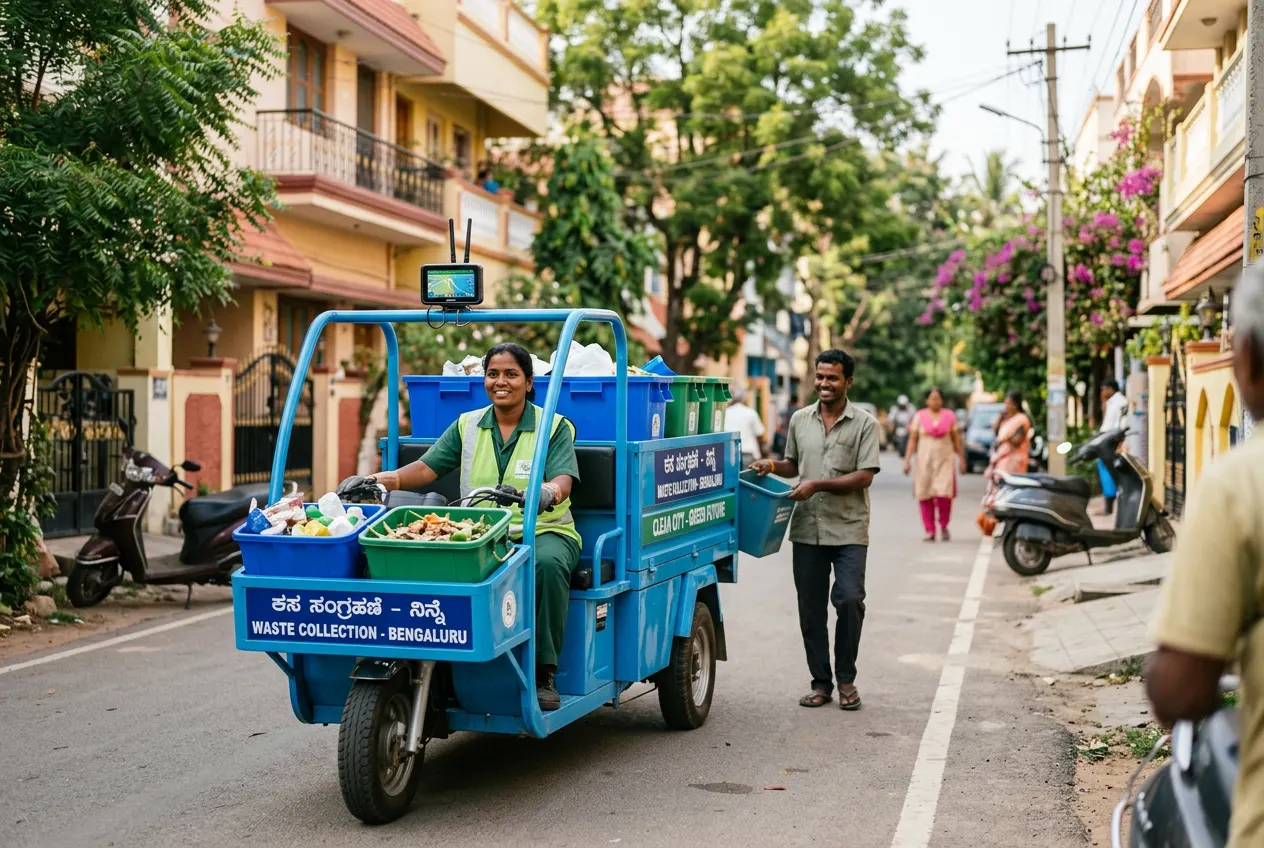
Achieving 100% Door-to-Door Collection with GPS Tracking
How ULBs can reach and sustain 100% door-to-door waste collection using GPS vehicle tracking, route monitoring, and simple accountability systems that hold coverage long after launch.
Door-to-door collection is the pivot on which the entire waste system turns. If waste is not reliably collected in a segregated form from every household, everything downstream, from composting to recycling to landfill diversion, degrades. Reaching 100% coverage is a common target under the Swachh Bharat Mission (Urban) and a heavily weighted parameter in Swachh Survekshan, but many cities plateau at "most households, most days" and struggle to prove otherwise when the assessors arrive.
GPS tracking is the tool that converts a coverage claim into a coverage fact. By instrumenting collection vehicles and routes, a ULB can see which streets were actually serviced, when, and by whom, and can close the gaps that surveys alone never reveal. But the technology is only half the story; it works because it makes an operating model visible and accountable, and this guide covers both the tool and the discipline around it.
Why door-to-door collection is the critical link
In the waste value chain of segregation, collection, transport, processing, and disposal, collection is the link that either preserves or destroys everything the household did right. A resident who segregates carefully is undone if the crew tips both bins into one vehicle, or if the vehicle skips the street entirely and the waste ends up in a drain. Getting collection right is therefore not just about coverage numbers; it is about protecting the segregation that makes composting and recycling possible.
Why coverage stalls
Understanding the failure modes tells you what to instrument. Coverage typically breaks down for a handful of predictable reasons, and each has a monitoring answer.
- Vehicles skip narrow lanes, peripheral colonies, or difficult-access clusters where oversight is weakest.
- Inconsistent timings mean residents miss the vehicle and dump on the street instead.
- Segregated waste is re-mixed at informal transfer points, so effective coverage is lower than it looks.
- There is no independent record, so unserviced streets stay invisible until complaints pile up.
What GPS tracking actually delivers
A vehicle-tracking system does more than show dots on a map. Configured well, it produces the evidence base for managing collection as an operation rather than a hope.
- Route adherence: did the vehicle cover its assigned beat, or cut it short?
- Trip completion and frequency per ward, verifiable day by day.
- Time stamps that expose chronic early finishing or missed segments.
- A historical record to settle disputes, target supervision, and evidence coverage claims to assessors.
Designing the operating model for reliability
Technology only helps if the underlying design is sound. Before procuring devices, map every collection beat to a named route, a vehicle, and a crew, so that a gap on the map points to an accountable person rather than a vague "system failure". Fix service windows for each area and publish them, because predictability is what keeps waste off the street. Then use the tracking data to rebalance routes that are overloaded or under-served, treating route design as something that is tuned continuously, not set once.
Adding household-level assurance
GPS confirms the vehicle reached the street; it does not confirm every household handed over segregated waste. Some cities close this last gap with lightweight confirmation methods, such as RFID or QR tags on bins or gates that crews scan, or a simple resident-feedback channel. Keep it proportionate: the goal is assurance, not a surveillance system that crews will quietly sabotage. A method the crew resents is a method that stops working within a month.
Turning data into accountability
Data changes nothing unless someone acts on it. Establish a short daily rhythm where a supervisor reviews the previous day’s route completion and follows up on gaps before they become complaints. A public grievance channel, ideally integrated with the tracking system, closes the loop by letting residents report misses that the crew can then be sent back to fix.
- Review route-completion dashboards every morning, not every month.
- Link recurring gaps to specific routes and crews for corrective action.
- Resolve grievances within a defined time and track the resolution rate as a core metric.
Protecting segregation, not just coverage
A hundred percent collection of mixed waste is a hollow achievement. Pair coverage tracking with partitioned vehicles and a firm rule against collecting unsegregated waste, so that the coverage you prove is coverage of separated streams. Otherwise the city simply transports its mixing problem more efficiently to the dumpsite, and the composting and recycling that justify the whole system never get clean feedstock.
Common pitfalls with GPS-enabled collection
- Buying devices before mapping routes, so the data has no accountable owner to act on it.
- Reviewing dashboards monthly instead of daily, letting gaps harden into citizen complaints.
- Neglecting device and vehicle maintenance, so tracking coverage silently decays.
- Chasing a coverage percentage while ignoring whether the waste collected is actually segregated.
Sustaining 100%
Reaching full coverage is easier than holding it, because attention drifts once the target is announced achieved. Sustained performance comes from routine, not campaigns: fixed routes, daily data review, prompt grievance resolution, and maintenance of both vehicles and devices. A ULB that treats collection as a monitored daily operation will keep coverage near 100% long after the launch event is forgotten, and will have the tracking records to prove it when the Swachh Survekshan assessors arrive.
How Social Lab helps cities hit and hold coverage
Social Lab helps ULBs move from claimed coverage to proven coverage by combining route mapping, GPS-enabled vehicle monitoring, partitioned segregated collection, and a daily supervisory rhythm with an integrated grievance channel. Because the same data feeds the ULB’s monitoring and evaluation, cities get one system that runs collection, resolves citizen complaints, and generates the evidence funders and Swachh Survekshan assessors expect, without adding a surveillance burden the crews will resist.
Key takeaways
- Collection is the value-chain link that protects or destroys segregation, so coverage must always mean coverage of separated streams.
- GPS tracking turns coverage claims into verifiable facts, but only when every beat is mapped to a named route, vehicle, and crew.
- Daily data review, prompt grievance resolution, and device maintenance are what sustain 100% coverage after launch.
- Keep household-level assurance proportionate so crews cooperate rather than sabotage it.
Frequently asked questions
Does GPS tracking guarantee 100% collection on its own?
No. GPS makes gaps visible, but coverage only improves if someone reviews the data daily and acts on it. The technology is an accountability tool, not a self-correcting one. Cities that buy devices without building the supervisory routine around them get dashboards nobody reads and coverage that does not move.
How do we confirm households actually segregate, not just that the vehicle passed?
Pair route tracking with partitioned vehicles, a firm no-mixed-waste rule, and lightweight household confirmation such as QR or RFID tags or resident feedback. Keep it simple and non-intrusive; the aim is assurance that separated streams are being handed over, not a heavy surveillance layer that field crews will undermine.
What is the most common reason cities backslide after reaching full coverage?
Loss of routine. Once the target is declared met, supervisory attention drifts, devices and vehicles go unmaintained, and grievances stop being resolved promptly. Coverage decays quietly until complaints resurface. Sustained coverage is a product of daily discipline, not the launch event.
Get a free, no‑obligation assessment from our team — we reply within one business day.