From Dumpsite to Circular Economy: A Municipality’s Playbook
A step-by-step playbook for municipalities to reclaim legacy dumpsites through bio-mining and build a circular waste economy that keeps them empty for good, aligned with SWM Rules 2016 and SBM-U.

Almost every Indian city carries a mountain of its own past: a legacy dumpsite where decades of mixed waste have piled up, catching fire, leaching into groundwater, and occupying land the city badly needs. Clearing it feels impossible, so many municipalities simply keep adding to it. But the dumpsite is not just a problem to be endured. It is the starting point for a transition to a circular waste economy, and reclaiming it can be the moment a city changes direction for good.
This playbook lays out that transition in sequence: remediate the old, redesign the new, and make sure the dump never fills again. The Solid Waste Management Rules, 2016 and the Swachh Bharat Mission (Urban) both push cities toward exactly this outcome of remediated legacy sites and garbage-free operation. The trap to avoid is treating remediation as a one-off clearance while leaving the linear system that created the dump untouched, because then the mountain simply rebuilds.
Step 1: Assess the legacy dump
Reclamation begins with knowing what is in the mountain. Survey the site to estimate the volume of legacy waste, its composition, and the footprint it occupies, and assess the surrounding risks to groundwater, air, and nearby communities. This assessment sizes the remediation effort and tells you what the site can become afterward. It also establishes the baseline against which the whole project will later be evaluated.
Step 2: Reclaim through bio-mining and bio-remediation
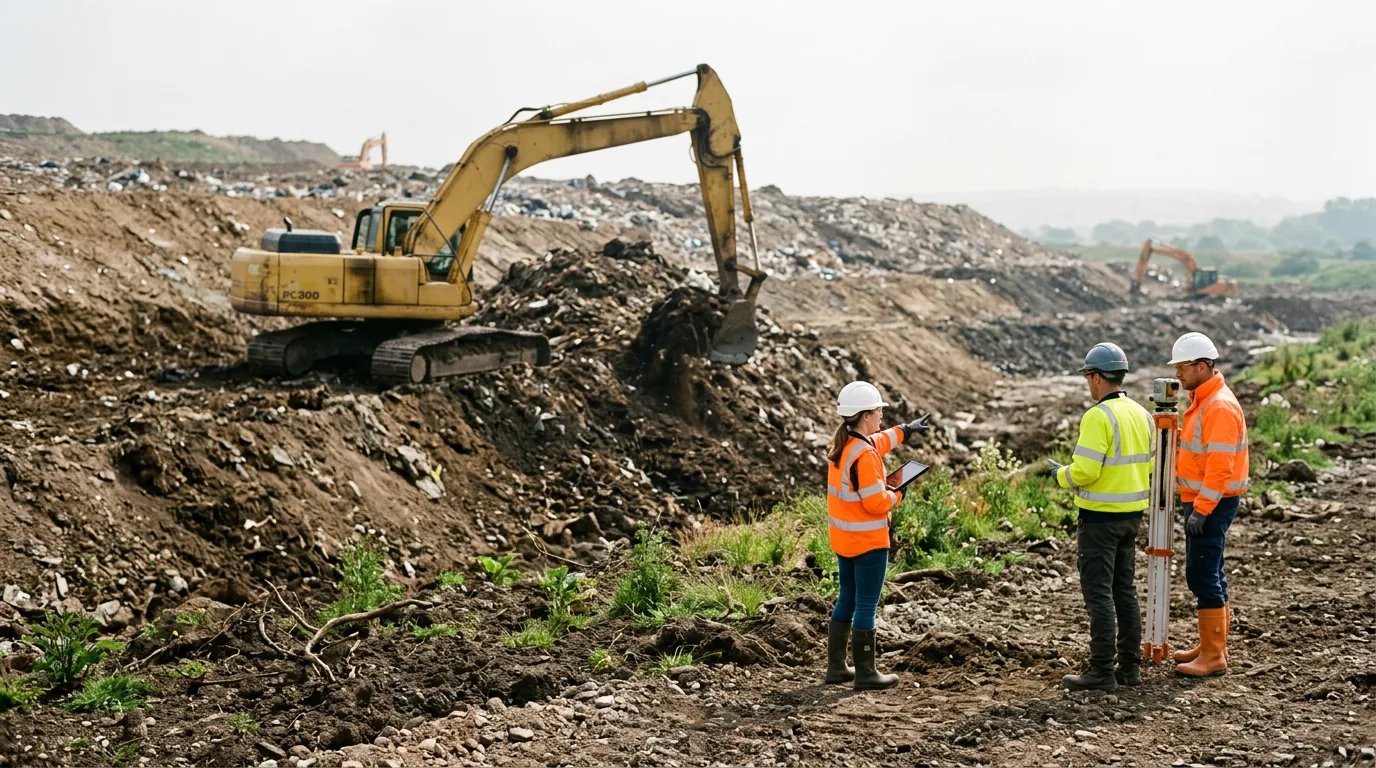
Legacy dumpsites are commonly reclaimed through bio-mining: the aged waste is stabilised, then excavated and mechanically screened to separate it into usable fractions. What comes out is not garbage but material and, above all, land.
- Soil-like fine fraction usable for landscaping, filling, or bio-cover.
- Combustible fraction that can be processed into refuse-derived fuel (RDF).
- Recyclables recovered for the material economy, often with wastepicker collectives.
- A small inert residue for scientific disposal, plus the reclaimed land itself.
Step 3: Put the reclaimed land to work
The single biggest prize of remediation is usually the land. Once a dumpsite is cleared, the recovered plot can host the very infrastructure the city needs for a circular system, such as a modern processing facility, a material recovery centre, or green public space. Reclaimed land turns a liability into an asset and often improves the economics of the whole exercise, since the alternative was acquiring new land elsewhere at a premium.
Step 4: Stop feeding the dump by rebuilding the value chain
Remediation is pointless if fresh mixed waste keeps arriving. This is where the circular system replaces the linear one, and the sequence mirrors any sound roadmap across segregation, collection, transport, processing, and disposal.
- Segregation at source into wet, dry, and hazardous streams, sustained by continuous IEC.
- Segregated door-to-door collection with GPS-enabled route monitoring to protect the separation.
- Decentralised composting or biomethanation for wet waste, close to where it is generated.
- Material recovery facilities and wastepicker integration for dry waste.
Step 5: Build the markets that close the loop
A circular economy needs buyers for its outputs. Line up offtake for each stream so recovered material leaves the city as product, not as a new stockpile: FCO-compliant compost for farms and landscaping, sorted recyclables for industry, and RDF for cement kilns or other users. Extended Producer Responsibility obligations on brand owners can help fund and pull dry-waste recovery, giving the city both a buyer and a co-funder for the same stream.
Step 6: Restrict disposal to genuine rejects
In a circular system the landfill shrinks to a minor role. Only inert, non-recoverable rejects should reach an engineered sanitary landfill, never mixed municipal waste. Sizing new disposal for rejects only, rather than for everything, is what keeps the city from simply building the next dumpsite on the land it just reclaimed.
Step 7: Institutionalise so it lasts
The final step is making the change permanent. Assign clear ownership, budget for ongoing operations and not just the one-time remediation, monitor the core outcomes on a fixed cadence, and keep the informal sector integrated rather than displaced. CSR and development partners can accelerate specific pieces, but the municipality has to own the system for it to endure.
Common pitfalls on the journey
- Bio-mining the dump while leaving the linear collection system untouched, so the mountain rebuilds within a few years.
- Recovering RDF or fines with no confirmed offtaker, turning one stockpile into several.
- Budgeting the one-time remediation but not the ongoing O&M of the new circular system.
- Displacing the wastepickers who could have recovered recyclables during and after bio-mining.
How Social Lab helps municipalities make the transition
Social Lab helps municipalities and their CSR partners treat dumpsite reclamation as a change of direction rather than a one-off clearance: legacy assessment and bio-mining planning, a reclaimed-land use plan, and, crucially, the redesigned value chain, segregation and IEC, GPS-enabled segregated collection, decentralised processing, wastepicker integration, and market linkage, that keeps the site empty afterward. With monitoring built in and the system institutionalised in the ULB with an O&M budget, the city clears its mountain once and is designed never to build another.
Key takeaways
- Bio-mining recovers not just land but a soil-like fraction, RDF, and recyclables, turning a liability into assets.
- Remediation only lasts if the linear collect-transport-dump system is replaced with a segregated circular value chain.
- Secure offtake for compost, recyclables, and RDF, and restrict new disposal to inert rejects only.
- Institutionalise the new system in the ULB with clear ownership, an O&M budget, and continuous monitoring.
Frequently asked questions
What exactly is bio-mining and what does it produce?
Bio-mining is the reclamation of an old dumpsite by stabilising the aged waste, then excavating and mechanically screening it into usable fractions: a soil-like fine fraction, a combustible fraction suitable for RDF, recoverable recyclables, and a small inert residue for scientific disposal. Its biggest output is often the reclaimed land itself, which can then host circular-economy infrastructure.
Why do reclaimed dumpsites sometimes fill up again?
Because the city cleared the mountain but never fixed the linear system that built it. If mixed waste keeps arriving because segregation, segregated collection, and processing were not put in place, the site simply refills. Remediation and value-chain redesign have to happen together; one without the other is temporary.
Can a municipality fund this transition through CSR or EPR?
Partly. CSR and development partners can accelerate specific pieces such as MRF setup, wastepicker organisation, or IEC, and EPR can fund and pull dry-waste recovery. But the municipality must own and budget the ongoing operation for it to endure. External funding is best used to build durable capacity, not to substitute for the ULB’s own O&M responsibility.
Get a free, no‑obligation assessment from our team — we reply within one business day.