High-Impact CSR Waste-Management Projects: What Good Looks Like
A guide for CSR teams on designing waste-management projects that deliver real, lasting impact rather than one-off cleanups, with practical selection criteria and an exit-first design approach.
Waste management is a popular CSR theme because it is visible, tangible, and easy to photograph. That popularity is also its weakness: too many corporate programmes fund one-off cleanup drives, donate a few bins or vehicles, and move on, leaving nothing that outlasts the press release. High-impact CSR looks different. It builds systems, strengthens institutions, and can still be running years after the funding partner has exited.
For CSR teams, the question is not "what can we do that looks good" but "what change will still exist in three years, and can we prove it caused it." Answering that well means understanding the waste value chain the project plugs into, designing for handover from the start, and measuring outcomes rather than activities. This guide sets out what genuinely high-impact waste projects have in common.
Understand the system you are funding
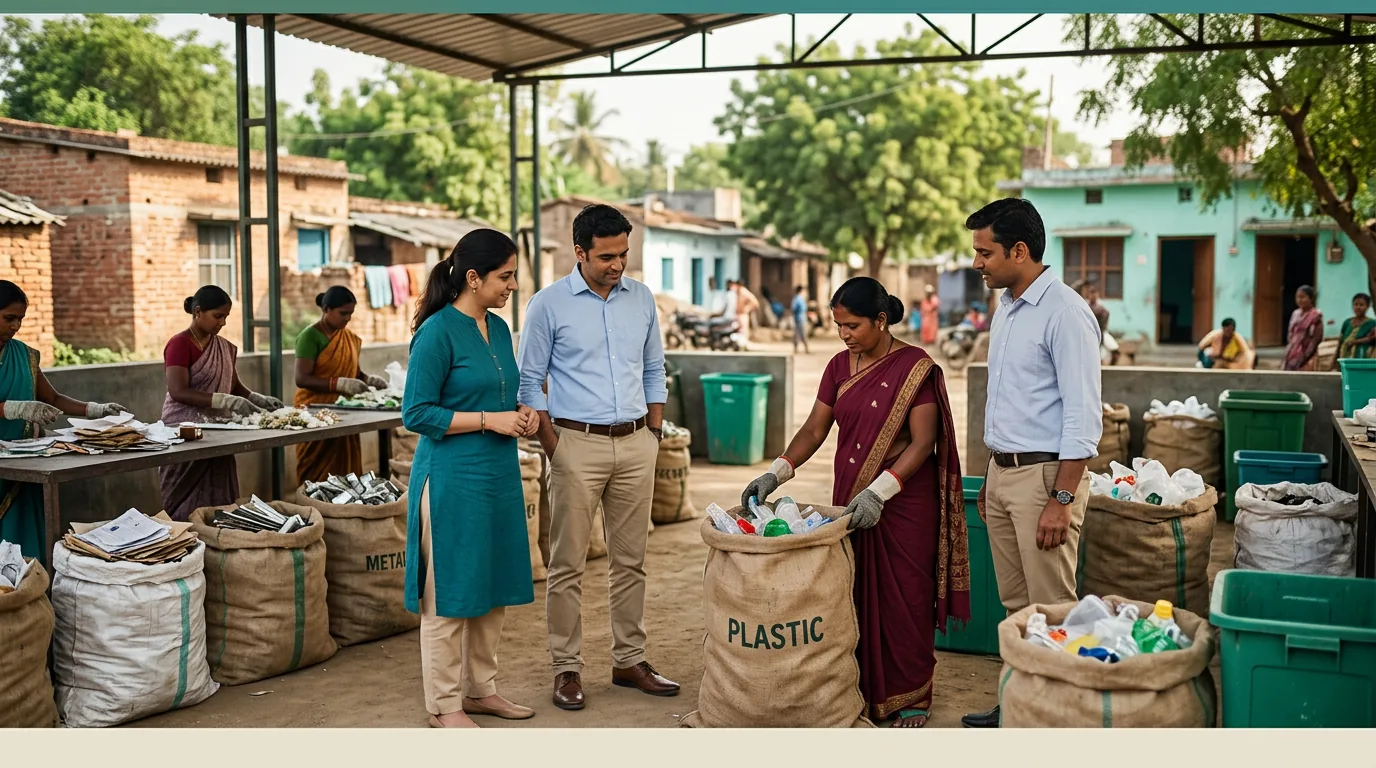
Waste flows through a chain: segregation, collection, transport, processing, and disposal, run by the ULB, its safai karmacharis and crews, wastepicker collectives, and processing operators. A CSR project that ignores this system funds an activity that the system quietly reabsorbs. The highest-impact spending strengthens a specific, weak link in that chain, a missing MRF, an unorganised wastepicker group, a collection blind spot, in a way the ULB can then sustain.
Fund systems, not events
A cleanup drive resets a location to zero; a week later the waste is back because nothing about the underlying system changed. The most valuable CSR money goes into the parts of a waste system that public budgets struggle to fund: the setup, the capacity building, and the working capital that gets a durable operation off the ground.
- Establishing decentralised composting or material recovery facilities with a clear operator.
- Organising and training wastepicker collectives into contracted service providers.
- Behaviour-change and segregation (IEC) campaigns run long enough to actually shift habits.
- GPS-enabled collection monitoring and the data systems that make a ULB accountable.
Partner with the ULB from day one
Waste is a municipal function. A CSR project that ignores the ULB creates a parallel structure that collapses the moment funding stops. Anchoring the project in a partnership with the local body, ideally through a formal agreement, ensures the intervention fits the city’s system, has somewhere to hand over to, and can be sustained on public budgets afterward. This alignment also lets the project reinforce the ULB’s obligations under the SWM Rules 2016 and its Swachh Bharat Mission goals rather than working around them.
Design the exit before the entry
The test of a good CSR waste project is what happens when the company leaves. Design the handover at the start: who operates the facility, who pays for operations and maintenance, and what revenue or municipal budget sustains it. A project with no answer to "who runs this in year four" is a donation, not an investment.
- Identify the long-term operator, cooperative, ULB unit, or social enterprise, up front.
- Build an operating-cost model with a realistic revenue or budget line.
- Phase your funding to taper as local ownership and revenue grow.
Choose interventions with compounding value
The strongest projects deliver on several fronts at once, which is also what makes them attractive for CSR reporting against social, environmental, and livelihood objectives. Wastepicker integration, for example, improves recycling, reduces landfill load, and lifts vulnerable workers into secure livelihoods. Decentralised composting cuts methane emissions, reduces transport costs, and produces a useful soil input. Look for these multi-benefit interventions rather than single-purpose spending.
Insist on measurement
What good looks like includes knowing whether it worked. Build monitoring in from the start with a baseline, a small set of meaningful indicators, and honest reporting. Tonnes of waste diverted from landfill, households reliably segregating, workers formalised and earning, and greenhouse-gas emissions avoided are far more credible than the number of bins distributed or the length of a cleanup drive.
- Capture a baseline before the intervention so change is attributable.
- Track outcomes such as tonnes diverted and livelihoods created, not just activities.
- Report failures and course corrections, not only successes.
Red flags to avoid
- Donating hardware with no operator, maintenance plan, or budget behind it.
- One-off drives with no mechanism to prevent the waste returning.
- Projects designed around a photo opportunity rather than a measured outcome.
- Ignoring the informal sector already doing the work you are about to fund.
How Social Lab helps CSR teams deliver lasting impact
Social Lab helps CSR teams design and run waste projects that survive their exit: ULB partnership from day one, interventions chosen for compounding value, an explicit operator and handover plan, and monitoring and evaluation built in from the baseline. The result is reporting a CSR team can defend, outcomes such as tonnes diverted and livelihoods formalised rather than bins distributed, and a system that keeps improving lives after the funding tapers away.
What good looks like, in one line
A high-impact CSR waste project leaves behind a working system, owned by a local institution, funded to keep running, serving real people, with measured results to show for it. If a programme can still be found operating and improving lives several years after the company exits, it was worth doing. If it needed the company to keep showing up, it was a subsidy in search of a story.
Key takeaways
- Fund systems and capacity, not events; cleanup drives reset to zero because the underlying system never changed.
- Anchor every project in a ULB partnership so it has somewhere to hand over to and can be sustained on public budgets.
- Design the exit before the entry: name the operator, model the O&M cost, and taper funding as local ownership grows.
- Measure outcomes such as tonnes diverted and livelihoods created, with a baseline, not activities such as bins distributed.
Frequently asked questions
Why are cleanup drives considered low-impact?
Because they treat a symptom, not the system. A drive clears a site once, but if segregation, collection, and processing have not changed, the waste returns within days. Cleanups can have value as engagement or IEC moments, but on their own they leave nothing durable behind and should not be mistaken for system change.
How do we prove our CSR project actually caused the change?
Capture a baseline before the intervention and track a small set of outcome indicators against it over time. Attribution is only possible when you know the starting point. Reporting tonnes diverted, segregation rates, and livelihoods formalised against a documented baseline is far more credible than counting activities, and it is what serious impact assessment expects.
Should CSR fund infrastructure or operations?
Both, but with an exit plan. CSR is well suited to funding setup and initial working capital that public budgets struggle to release, provided there is a clear answer to who covers operations and maintenance once the grant tapers. Funding hardware with no operator or O&M line is the classic way a well-meaning project becomes an abandoned asset.
Get a free, no‑obligation assessment from our team — we reply within one business day.