
Which EPR Rules Apply to Your Business? A Decision Guide to India’s Extended Producer Responsibility Regimes
Plastic, e-waste, batteries, tyres and used oil — a practical decision guide to figuring out exactly which of India’s EPR frameworks your company is obligated under, why one product can trigger several, and how to run a company-wide obligation audit.
India now runs several parallel Extended Producer Responsibility (EPR) frameworks, each notified under its own set of rules and administered largely through Central Pollution Control Board (CPCB) portals. Each was created for a specific waste stream, and each has its own definitions, registration process and reporting cadence. Because they were introduced at different times and cover different products, it is entirely possible for one company to be obligated under three or four of them simultaneously without ever realising it.
This guide helps you work out which regimes apply to you. The test in every case is the same: look at what you manufacture, import, or sell under your brand, and match it against the product streams each rule covers. This article gives you the questions to ask, explains why a single product can trigger several regimes at once, and outlines how to run a company-wide obligation audit so nothing is missed.
The main EPR regimes in force
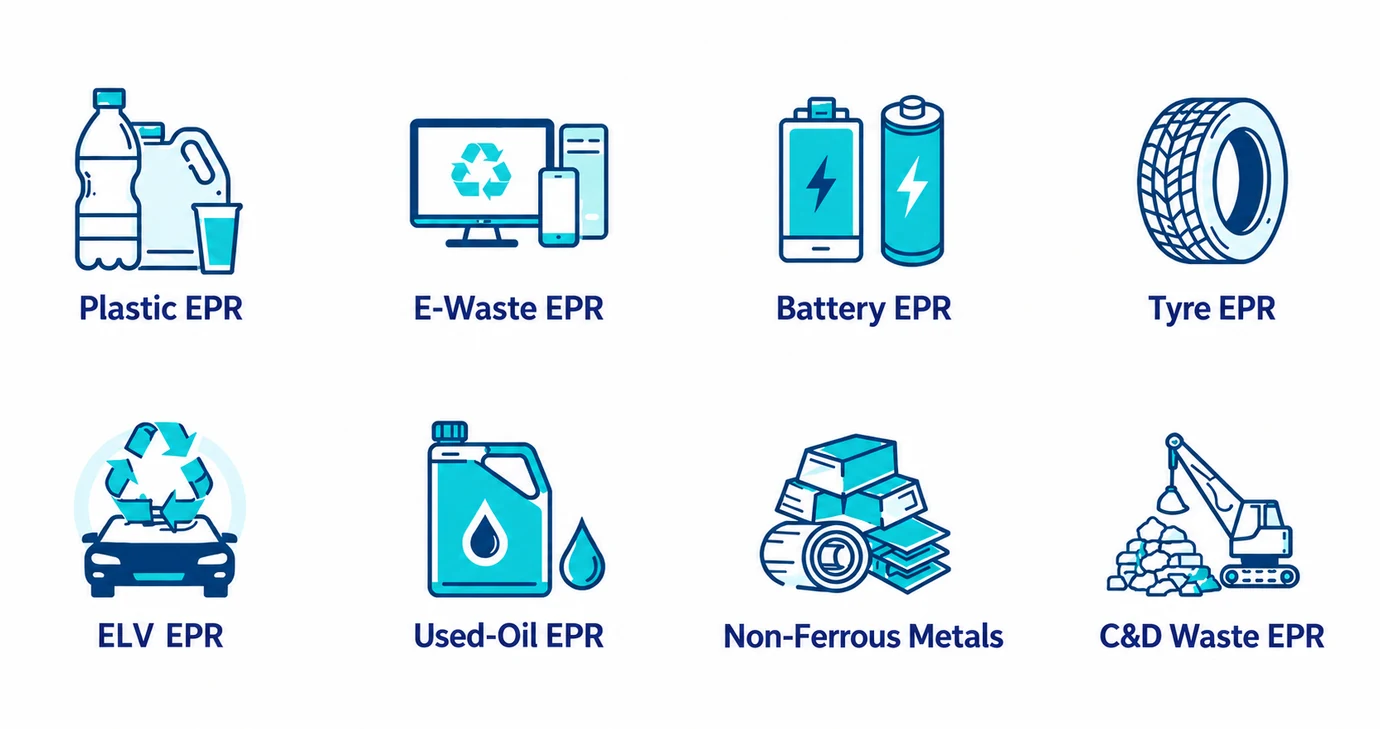
The most established EPR frameworks, each with a dedicated CPCB registration and reporting system, cover the following waste streams:
- Plastic packaging — under the Plastic Waste Management Rules, 2016 (as amended), with the EPR Guidelines added in 2022.
- Electrical and electronic equipment — under the E-Waste (Management) Rules, 2022.
- Batteries of all types — under the Battery Waste Management Rules, 2022.
- Waste tyres — under the EPR provisions notified for waste tyres.
- Used or waste oil — under the EPR provisions notified for used oil.
The regulatory landscape continues to expand, and additional EPR-style obligations attach to other hazardous and specialised waste streams over time. Because notifications are added and revised, treat any list as a starting point and confirm the current set of notified regimes on the official CPCB and Ministry of Environment, Forest and Climate Change (MoEFCC) sources.
Ask these questions about your business
Run through each of these questions about your products, your imports and your brands. A yes to any of them signals an obligation worth investigating properly rather than assuming it does not apply:
- Do you sell any product under your own brand in plastic packaging? Plastic packaging EPR very likely applies to you as a brand owner.
- Do you manufacture or import plastic packaging or carry bags? Plastic packaging EPR applies as a producer or importer.
- Do you make, import or sell electronics — IT equipment, appliances, lighting, medical devices, or their components? E-waste EPR likely applies.
- Do you make, import or sell batteries, or products containing batteries (including EVs, tools and gadgets)? Battery waste EPR likely applies.
- Do you produce, import or retread tyres, or import vehicles fitted with tyres? Tyre EPR may apply.
- Do you produce or import lubricating or base oils? Used oil EPR may apply.
Why one product can trigger several regimes
Consider a company importing cordless power tools. The tool itself is electrical and electronic equipment, which brings e-waste obligations. It contains a rechargeable battery, which brings battery obligations. It ships in a printed carton with plastic wrap and moulded inserts, which brings plastic packaging obligations. A single product line can therefore create three distinct registrations, each with its own target, its own portal and its own annual return.
The same layering happens across many sectors. An automotive importer brings in vehicles (tyres, batteries, plastic packaging on parts). An electronics brand ships gadgets with batteries in laminated pouches. A lubricants company sells oil in plastic containers. This is precisely why reacting to one rule at a time is unreliable — you fix the obligation in front of you and remain blind to the two behind it.
Running a company-wide obligation audit
A role-and-product audit at the company level is far more dependable than a rule-by-rule reaction. The method is straightforward and, done once properly, becomes a living reference you update as your product range changes:
- List every product you manufacture, import or sell under your brand.
- For each product, itemise its components — the device, any battery, any tyre, and every element of its packaging.
- Match each component against the regimes above, and note the role you play (producer, importer, brand owner).
- Record the quantity or weight of each obligated item you place on the market, since this drives every target.
- Confirm the current registration requirements for each identified regime on the official portal.
The output is a matrix of products against regimes that tells you exactly where you are obligated, in what role, and against what volumes. It also surfaces obligations you might otherwise miss entirely — the battery inside an imported device, or the packaging on a product you assumed was someone else’s responsibility.
What every regime shares
Although the rules differ in detail, the EPR frameworks follow a common shape. Learning this pattern once makes each additional regime far easier to manage:
- You register on the relevant CPCB portal in your applicable role.
- You declare the quantity you place on the market, by the categories or types that regime uses.
- You carry an annual collection or recycling target derived from that quantity.
- You fulfil the target, usually by procuring EPR certificates from registered recyclers.
- You file periodic annual returns reconciling obligation against fulfilment.
How Social Lab helps
Social Lab runs company-wide EPR obligation audits that map every product line and its packaging against all applicable regimes, so you see the full picture rather than one rule at a time. From there we sequence registrations sensibly, build a single internal data system that feeds every return from the same underlying sales and import records, and manage ongoing certificate procurement across regimes. For businesses with layered obligations — electronics with batteries in plastic packaging, or vehicles with tyres and batteries — consolidating everything under one compliance calendar removes the risk of a hidden, unregistered obligation surfacing later.
Key takeaways
- India runs several parallel EPR regimes — plastic packaging, e-waste, batteries, tyres and used oil — each with its own rules, portal and returns.
- The test for each is the same: match what you manufacture, import or brand against the stream the rule covers.
- A single product can trigger several regimes at once — an imported gadget can carry e-waste, battery and plastic packaging obligations simultaneously.
- A company-wide product-and-role audit is more reliable than reacting to one rule at a time and surfaces hidden obligations.
- All regimes share a common shape — register, declare, carry a target, fulfil via certificates, file returns — so one data system can serve them all.
Frequently asked questions
Can a small business really be obligated under multiple regimes?
Yes. Obligation is driven by what you place on the market, not by company size. A small importer of branded electronics in plastic packaging can be obligated under e-waste, battery and plastic packaging rules at once. Thresholds and specifics vary by regime, so confirm each against the current notification.
If I use a third-party manufacturer, are they responsible instead of me?
Generally no. If you sell the product under your own brand, you are typically the obligated brand owner regardless of who manufactured it. The definitions across regimes are drawn wide precisely to prevent responsibility being passed down the chain.
Where do I confirm which regimes currently exist?
The official CPCB portals and MoEFCC notifications are the authoritative sources. New EPR-style obligations are added over time, so treat any published list, including this one, as a starting point to verify against the current notifications.
Get a free, no‑obligation assessment from our team — we reply within one business day.