
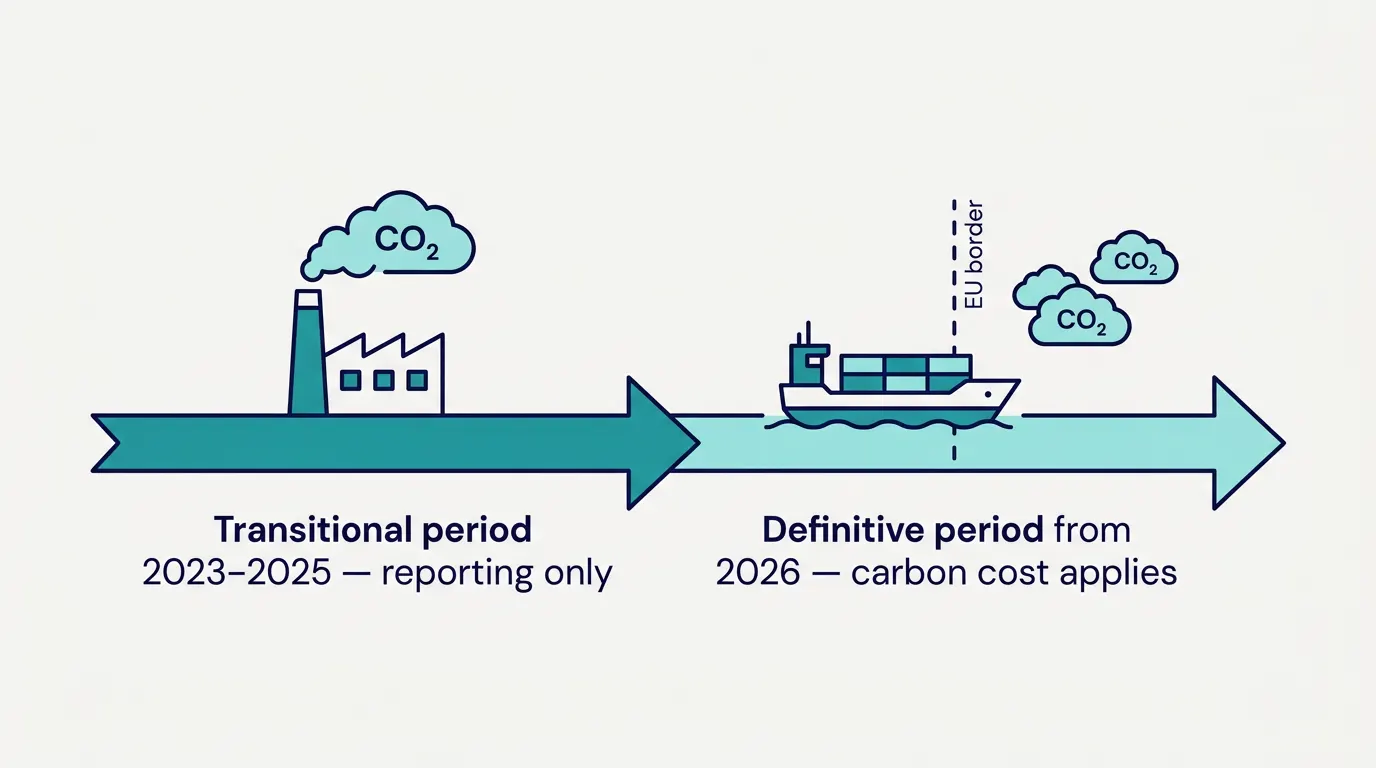
CBAM Transitional vs Definitive Period: What Changes from 2026
CBAM shifts from reporting-only to paying from 2026. A detailed comparison of the transitional and definitive periods — obligations, certificates, data quality, verification — and what Indian exporters must prepare for.
CBAM has always been designed to arrive in two stages. The first, the transitional period, was a reporting-only warm-up that ran from 1 October 2023 to 31 December 2025. The second, the definitive period, begins on 1 January 2026 and is where the carbon cost becomes real. For Indian exporters, understanding exactly what changes at that boundary is the difference between a smooth transition and a nasty surprise — because while the legal obligation shifts for your EU buyer, the commercial impact lands squarely on your product.
This article compares the two periods in depth: what each requires, how obligations and data quality expectations differ, how CBAM certificates work, and what concrete preparation Indian exporters should complete. Throughout, remember that CBAM was established by Regulation (EU) 2023/956 and covers six sectors — iron and steel, aluminium, cement, fertilizers, hydrogen and electricity — defined at the level of CN codes.
The transitional period: report, do not pay
The transitional period ran from 1 October 2023 to the end of 2025. Its purpose was to build data and familiarity without financial consequences. In this phase:
- EU importers filed quarterly CBAM reports on the embedded emissions of covered goods.
- No CBAM certificates were bought and no charge was paid.
- Flexibility existed in reporting methods, including the use of default values and estimates in the early quarters.
- The focus was on collecting emissions data from suppliers and learning the process.
For you as an exporter, the transitional period was a rehearsal. Your buyers asked for emissions data; you learned to produce it in the EU's communication template. Nobody paid yet, but the habits built during this phase determine how ready you are for the definitive one. Exporters who used the transitional runway to move from defaults to actual installation data start the paying period with a real advantage.
The definitive period: pay for embedded carbon
The definitive period starts on 1 January 2026. This is when CBAM acquires financial teeth. The headline changes are:
- Importers must become authorised CBAM declarants to bring covered goods into the EU.
- Reporting moves from quarterly reports to an annual CBAM declaration of embedded emissions.
- Importers must buy CBAM certificates and surrender them to cover the declared embedded emissions.
- CBAM certificate prices are tied to EU ETS carbon prices, so the cost of your product's emissions tracks the EU carbon market.
- Embedded emissions must be verified by an accredited verifier, and reliance on default values is restricted in favour of actual data.
A carbon price already paid in the country of production can, in principle, be deducted from the CBAM obligation, but only where it can be clearly evidenced. This is why documentation of any domestic carbon cost matters — the amount, the emissions it covers, and proof of payment must all be available.
How CBAM certificates work
Under the definitive regime, the authorised CBAM declarant purchases CBAM certificates and surrenders enough of them to cover the embedded emissions declared for the goods they imported. The price of a certificate is linked to EU ETS allowance prices, so it is not a fixed number set in advance — it moves with the EU carbon market. As free allocation to EU domestic producers is phased out over time, the share of embedded emissions that must be covered by certificates is designed to increase in step. The practical consequence for you is that the carbon intensity of your goods becomes a live, market-priced input into your buyer's landed cost.
Side-by-side: what actually changes
- Obligation: reporting only, versus reporting plus payment through certificates.
- Reporting frequency: quarterly reports, versus an annual CBAM declaration.
- Who must be authorised: any importer could report, versus only authorised CBAM declarants may import covered goods.
- Data quality: defaults and estimates tolerated early, versus verified actual data expected.
- Verification: not required, versus verification by an accredited verifier.
- Financial impact: none, versus certificate cost linked to EU carbon prices.
Why this matters more for your buyer legally but for you commercially
Legally, the obligation to declare and pay sits with the EU importer, not with you in India. But commercially, the cost lands on your product. If your embedded emissions are high — or if you cannot supply data and conservative defaults are used — your goods become more expensive for the importer to bring in. That erodes your competitiveness against lower-emission suppliers who can prove a smaller footprint. In effect, your carbon performance becomes a price signal in the EU market, and the exporters who can document a low, verified figure will be the ones buyers keep.
How to prepare before and during 2026, and how Social Lab helps
Use the runway to get ready rather than reacting under deadline pressure:
- Move from default values to actual, installation-level emissions calculations using the EU methodology.
- Build a repeatable process to produce EU-format data each reporting cycle.
- Prepare for third-party verification of your emissions data.
- Document any carbon price paid in India so it can be considered for deduction.
- Talk to buyers now about becoming their preferred low-carbon, well-documented supplier.
Social Lab helps Indian exporters make exactly this transition: we convert transitional-era default reliance into verified actual-data calculations, set up a repeatable data cycle mapped to your buyers' declaration timelines, assemble verification-ready evidence, and document domestic carbon costs so they are not lost. The definitive period rewards exporters who can prove a low, verified carbon footprint and penalises those who cannot supply data. Treat 2026 as the moment to become the supplier EU buyers keep rather than the one they replace.
Key takeaways
- The transitional period (Oct 2023–Dec 2025) was reporting only via quarterly reports; the definitive period from 1 January 2026 adds payment.
- From 2026, importers must be authorised declarants, submit an annual CBAM declaration, and buy and surrender CBAM certificates.
- Certificate prices are linked to EU ETS carbon prices, so your product's carbon intensity becomes a market-priced cost for your buyer.
- Definitive-period data must be actual and verified by an accredited verifier, with defaults restricted.
- A documented carbon price paid in India can, in principle, reduce the certificate obligation.
Frequently asked questions
What is the single biggest change on 1 January 2026?
The shift from reporting only to paying. From that date, EU importers must be authorised CBAM declarants who submit an annual declaration and buy and surrender CBAM certificates to cover the embedded emissions of covered goods, at a price linked to the EU ETS.
Do I need to buy CBAM certificates myself?
No. CBAM certificates are purchased and surrendered by the authorised CBAM declarant — your EU importer — not by you. But the number of certificates they need, and therefore the cost of importing your goods, depends directly on your product's embedded emissions.
Are default values still allowed in the definitive period?
Their use is restricted. The definitive period expects actual, installation-level data verified by an accredited verifier. Default values remain a fallback in limited circumstances, but relying on them typically attributes higher emissions than a well-run installation's true performance.
How can I reduce the impact before 2026 bites?
Replace default values with verified actual data, build a repeatable EU-format reporting process, prepare for verification, document any Indian carbon price for possible deduction, and engage buyers early. These steps lower the emissions attributed to your goods and position you as a preferred low-carbon supplier.
Get a free, no‑obligation assessment from our team — we reply within one business day.